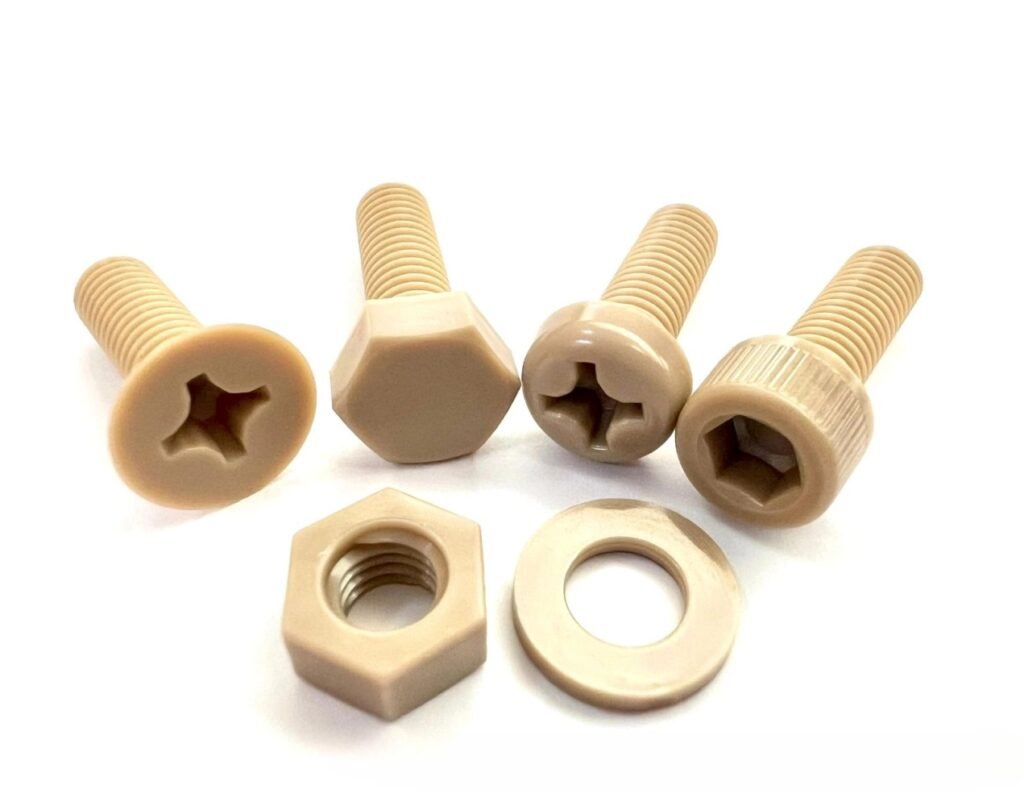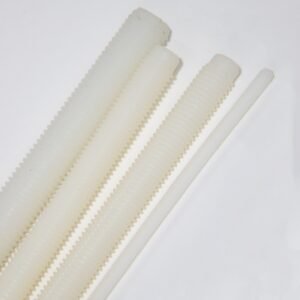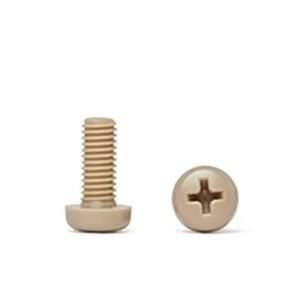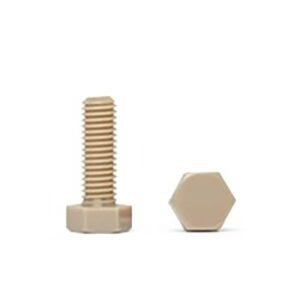
Polyetheretherketone Overview
Polyether Ether Ketone (PEEK) is a high-performance, semi-crystalline thermoplastic polymer known for its outstanding mechanical strength, chemical resistance, and exceptional thermal stability. It belongs to the polyaryletherketone (PAEK) family of polymers.
🧬 Chemical Structure and Classification
PEEK’s unique properties stem from its backbone structure.
- Polymer Family: It is a member of the PAEK (Polyaryletherketone) family. These polymers are characterized by repeating ether (5$\text{-O-}$) and ketone (6$\text{-CO-}$) linkages separated by aromatic rings (phenyl groups).
- Structure: PEEK’s repeating unit specifically contains two ether linkages and one ketone linkage between three benzene rings. This arrangement provides the rigidity necessary for high strength and the flexibility necessary for high impact resistance.
🔥 Key Properties and Performance
PEEK is one of the highest-performing polymers available commercially, often used to replace metals in demanding applications.
| Property | Description | Significance |
| Thermal Stability | High Melting Point ($343^\circ \text{C}$) and Glass Transition Temperature ($143^\circ \text{C}$). | Can operate continuously at temperatures up to $260^\circ \text{C}$ without significant loss of properties. |
| Mechanical Strength | Excellent stiffness, creep resistance, and fatigue resistance. | Maintains performance under heavy loads over long periods. |
| Chemical Resistance | Highly resistant to hydrolysis (water breakdown), organic solvents, and strong bases (alkalis). | Used in harsh chemical processing environments and medical applications. |
| Biocompatibility | Non-toxic and biologically inert. | Widely used for medical implants and surgical devices. |
| Wear & Abrasion | Excellent inherent lubricity and low coefficient of friction. | Ideal for bearing surfaces and moving components (e.g., gears). |
🛠️ Common Applications
PEEK’s combination of properties makes it suitable for extreme environments across various industries:
- Aerospace: High-temperature connectors, bushings, brackets, and structural components due to its lightweight and fire-retardant characteristics.
- Medical/Dental: Spinal cages, trauma fixation devices, and dental abutments, replacing titanium in some cases due to its radiolucency (doesn’t interfere with X-rays).
- Electronics: Insulators, wafer carriers, and high-performance connectors that require sustained dimensional stability at elevated temperatures.
- Oil and Gas: Pump gears, seals, valve components, and compressor plates that must withstand high pressures and exposure to harsh chemicals and steam.