
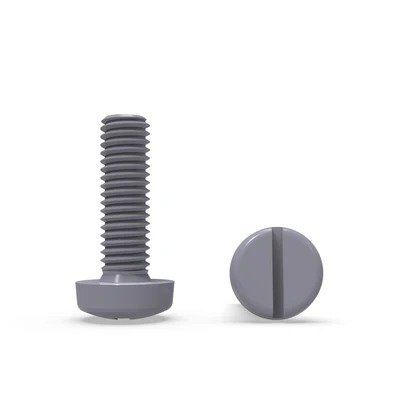
CPVC Slotted pan head screw Overview
CPVC (Chlorinated Polyvinyl Chloride) Slotted Pan Head Screw is a type of plastic screw utilized in applications requiring chemical resistance, high temperature tolerance (relative to standard PVC), and electrical insulation. The specific Pan Head design offers a large bearing surface for strong clamping, while the Slotted Drive allows for simple installation.
| Feature | Detail | Purpose |
| Material | CPVC (Chlorinated Polyvinyl Chloride) | Provides excellent chemical resistance, especially to acids, alkalis, and automotive fluids, at temperatures higher than standard PVC. |
| Head Style | Pan Head |
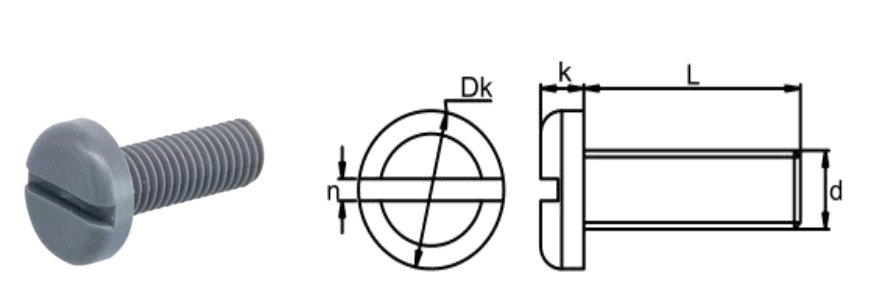
Product Parameters
CPVC Pan Head Screws typically follow standards such as ISO 7045 (Cross Recessed Pan Head) or equivalents for the slotted drive.
| Nominal Diameter (d) | Thread Pitch (P) | Head Diameter (D) | Head Height (K) | Slot Width (Approx.) |
| M3 | 0.5 mm | 6.0 mm | 2.4 mm | 0.8 mm |
| M4 | 0.7 mm | 8.0 mm | 3.1 mm | 1.0 mm |
| M5 | 0.8 mm | 9.5 mm | 3.7 mm | 1.2 mm |
| M6 | 1.0 mm | 11.0 mm | 4.4 mm | 1.6 mm |
Key Features
CPVC screws are chosen primarily for their environmental resistance profile:
Chemical Resistance: Excellent stability against most mineral acids, bases, and salts.
Thermal Tolerance: Better heat resistance than standard PVC, allowing for service temperatures higher than 90°C.
Electrical Insulation: Inherently non-conductive, offering good dielectric properties.
Cost-Effectiveness: More expensive than PVC but generally much more economical than high-performance polymers like PFA or PEEK.
Applications
- Automotive parts: engine covers, fans, gears
- Mechanical parts: bearings, gears, pulleys.
- Electronic and electronic components: switches, terminal blocks.
- Consumer goods: tool handles, sports equipment.
Advantages and Disadvantages
| Category | Advantage (Pro) | Disadvantage (Con) |
| Performance | Excellent corrosion resistance in contact with common chemicals; Good high-temperature rating for a vinyl polymer. | Low Mechanical Strength: Cannot withstand high loads or installation torque; Prone to creep under pressure. |
| Design | Pan head maximizes surface contact for good clamping; Cost-effective chemical resistance. | Slotted drive is prone to cam-out (slipping) and offers lower torque control compared to Phillips or socket drives. |
| Material | Lightweight, non-contaminating, and non-magnetic. | Poor UV resistance; Can be brittle in very cold temperatures. |
Packaging & Delivery
Standard packaging includes PE bag, foam cover, and one double-deck corrugated outer carton for safety during transit. Delivery time is 5-15 working days depending on the quantity.